Our Story


Forty years later, his family brought home a dog who couldn’t stop doing the same thing.

The signal reader
Too perceptive for the kennels.
Lady is a Belgian Malinois. She was bred for police drug detection. She failed — not because she couldn’t do it, but because she couldn’t stop. Too reactive. Too alert. A failure by every institutional metric. And she was exactly right. She reads the room — posture, breath, gaze, micro-hesitation — and she knows before you do. Thirty seconds before a trained human observer notices. Not because she’s faster. Because she reads signals humans have learned to ignore.
The systems that were supposed to catch this were never built to look. They measured compliance, not capability. That is what Poyntr was built to do. Not replace intuition. Amplify it. Read the signal before the crisis.
The realisation
For decades,
we asked.
With surveys. With check-ins. With every form HR could send.
We sent another survey.
On a scale of 1–10, how engaged do you feel today?
Rate your stress this week.
Are you experiencing signs of burnout?
How would you describe your mental health right now?
And the signals slipped past.
- Burnoutbefore the breakdown.
- Disengagementbefore the resignation.
- Distressbefore the crisis.
- Withdrawalbefore the safeguarding referral.
What if you didn’t have to ask?
How’s everything going?
Yeah, fine.
All of it was there. We just kept missing it.
The signal was always there.
In the pause.
In the word chosen.
In what they didn’t say.
We just hadn’t learned to listen at this level.
Until now.
Building Poyntr
Once you’ve seen it, you can’t unsee it.
So we built something that could.
Most leadership development doesn’t change behaviour. It describes it. We spent years in the room where learning happens — watching people grow, get stuck, and get stuck again — knowing that something fundamental was broken.
And one more thing
Irene’s Story
We didn’t invent the way to do this.
We just learned to do it at scale.
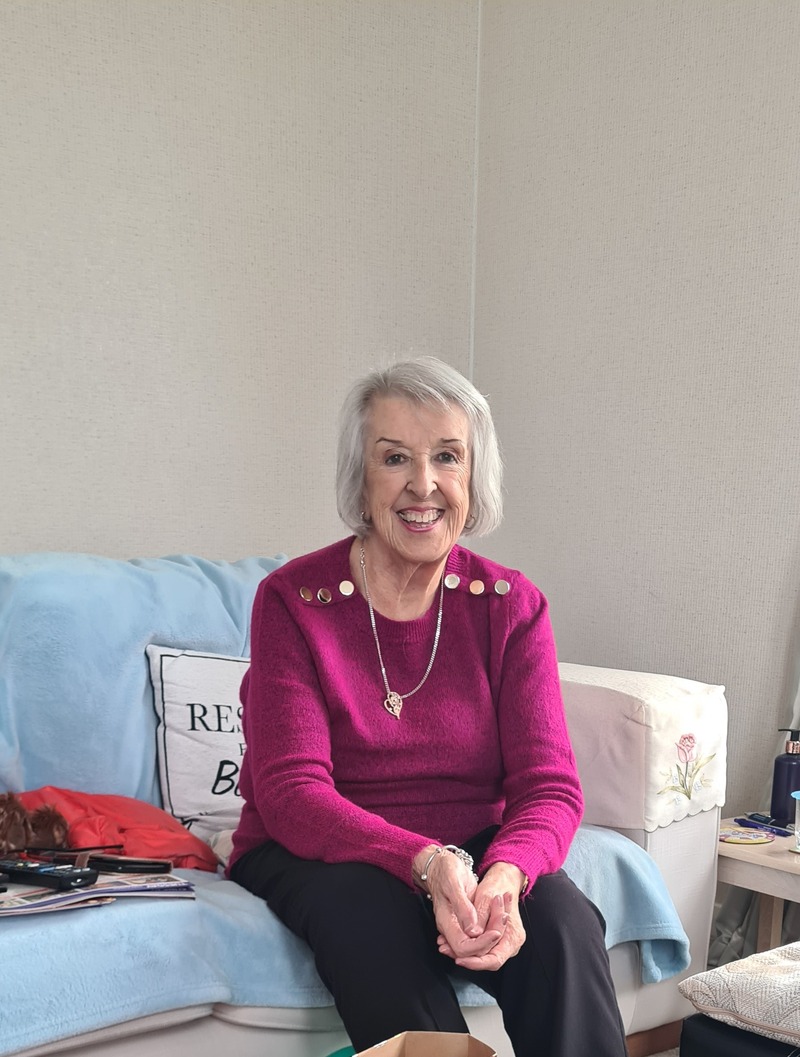
Long before there was any talk of coaching models, frameworks or technology, there was a simple belief about learning. It came from Irene Gannaway.
Irene was born into a poor family in 1943 and left school at 15. The opportunities that education can bring weren’t hers. But anyone who knew her will tell you the same thing — given the chance, she could have run anything she wanted. She had the instinct. She had the intelligence. She had the emotional read.
Instead she chose a different path: to be the best mother she could be, and to make a difference through her community, her voluntary work, and her way of being with people.
But it was her philosophy on learning that would leave the deepest legacy.
When her daughter was young and asked for help — whether with schoolwork or life — she rarely gave a straight answer. Instead, she would say:
“If I keep telling you the answer, you won’t be able to think. So I’m not going to tell you — I’ll give you some pointers.”
At times, this was frustrating. Like any child, her daughter would often say:
“Mum, just tell me the answer.”
But Irene persisted.
As the years went on, the questions evolved. School became college. College became work. Life brought harder things — relationships, decisions, difficult situations with people. Irene’s pattern never changed:
- “What do you think you should do?”
- “What would you like to do?”
- “What do you think they would want you to do?”
- “And would that work for you?”
Sometimes the answer came quickly. Sometimes it didn’t. But with gentle persistence — and the right questions — something began to happen:
Her daughter found her own answers.
One day, in frustration, her daughter asked:
“Why don’t you just give me your advice?”
Irene’s response was simple — and profound.
Because in a lot of situations, especially with people, my advice could be the wrong advice for you. My job is to help you find the answer that works for you.
That belief didn’t just shape one person. It became a way of being.
Today, in her community, Irene isn’t known for giving advice. She’s known for something more valuable. She listens. She notices. She asks thoughtful questions. She creates space.
And in that space, people find clarity.
They find their own answers.
And her daughter — now many years on — still finds herself saying:
“Mum… can I talk something through? Can you give me some pointers?”
What this means for us
This idea sits at the heart of everything we believe.
Real learning doesn’t come from being told what to do. It comes from being supported to think, reflect, and respond in a way that works for you.
Because the best answers aren’t given.
They’re discovered.
40 years on
Yes, Derek. It’s actually helping now.
Not because the technology got better. Because someone finally built it to listen the way Lady listens. To read the signal before the crisis. To treat every conversation as data, and every person as the point.
A leader gets honest feedback without asking for it.
85 signal types track growth, burnout, and disengagement. Coaching that remembers and gets sharper with every conversation.
A teacher notices the change before the referral.
109 behavioural detectors read what surveys never could. Real-time safeguarding across every conversation, every session.
A government minister sees this week, not three years ago.
Continuous national wellbeing intelligence. Updated weekly. Anonymised by design. The data that policy was always waiting for.
Technology earns its place, or it gathers dust.